How To Choose a Child-friendly Body Thermometer?
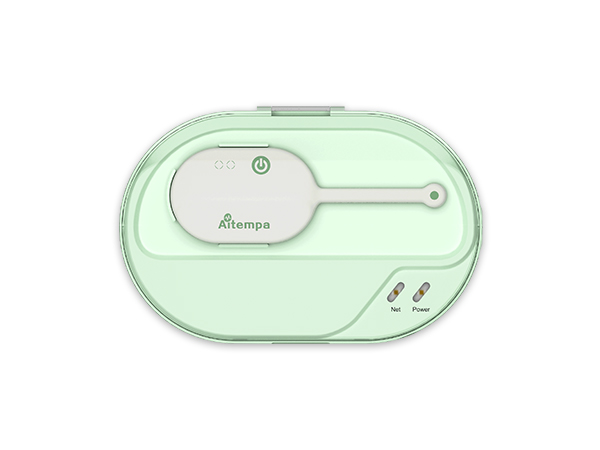
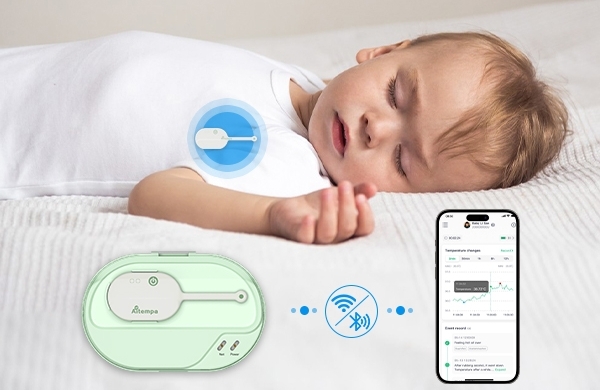
Measuring a child’s body temperature can be challenging, especially when the child feels uncomfortable or restless. Repeated manual checks may disturb sleep, cause resistance, or even affect measurement stability. To address these challenges, the Aitempa Smart Real-Time Body Thermometer was designed for continuous and comfortable temperature monitoring. Worn gently under the arm, it allows caregivers to track body temperature in real time without repeatedly waking or disturbing the child.
However, choosing a child-friendly body thermometer is not simply about selecting one product. Different measurement methods serve different purposes. Understanding how various thermometer types work can help parents determine which solution best fits their child’s age and monitoring needs.
1. What Makes a Child-Friendly Body Thermometer?
A child-friendly body thermometer should focus on comfort first. Children are often sensitive to unfamiliar devices, especially when they are already unwell. A gentle measurement method helps reduce resistance and anxiety.
Speed is also important. The faster the reading, the less chance a child will move and affect accuracy. At the same time, stable monitoring ensures that the temperature data remains consistent.
Ease of use cannot be ignored. Parents may need to check temperature late at night or during emergencies, so a clear display and simple operation make a real difference. And of course, safety comes first—skin-friendly materials and non-invasive measurement methods are essential for children.
2. Common Types of child-friendly body thermometer
There are several thermometer types commonly used for children, and each has its own advantages.
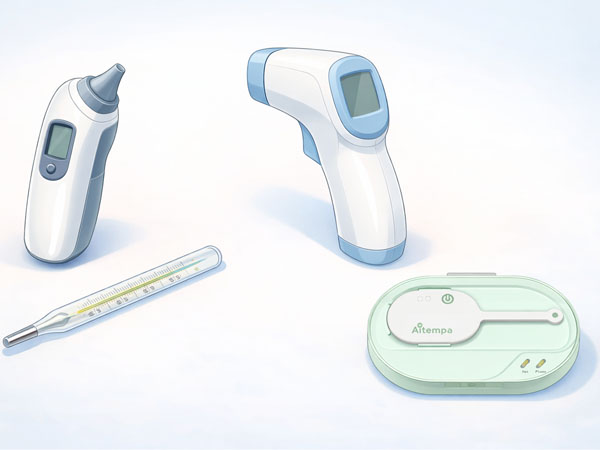
Non-contact infrared thermometers are convenient for quick checks. They are especially useful for short screenings or when children refuse contact. However, they are not designed for continuous monitoring.
Ear thermometers can provide reliable readings when used correctly, but they require proper positioning. For very active children, incorrect placement may affect accuracy.
Contact thermometers, including oral, rectal, and underarm methods, measure temperature through direct contact. Among them, axillary measurement is widely considered a safer and more comfortable option for children. It avoids invasive procedures while offering more stable readings than quick surface scans.
This is where wearable axillary thermometers offer a different approach.
3. Why Aitempa Real-time Body Thermometers Fit Certain Monitoring Needs
Unlike traditional handheld devices, Aitempa real-time body thermometers are designed to stay gently attached under the arm. Instead of taking repeated manual measurements, parents can monitor temperature continuously.
Because the device remains in place, real-time temperature trends can be viewed in the mobile app. This makes it easier to track fever patterns, observe post-vaccination reactions, or monitor recovery from infections. Rather than relying on a single reading, caregivers can see how the temperature changes over time.
The built-in Member List feature supports “one child, one record,” allowing families to store complete monitoring data for each child. This is especially helpful in households with multiple children or in pediatric care settings where organized data matters.
By combining comfort, continuous monitoring, and digital record management, Aitempa wearable axillary thermometers provide a practical solution for situations that require longer observation.
4. Age Matters: Choosing the Right Thermometer for Your Child
It’s important to remember that no thermometer works perfectly for every age group.
For newborns and very young infants, quick non-contact checks may be preferred in certain situations. Toddlers and young children, who tend to move frequently, may benefit more from wearable axillary thermometers that allow monitoring without repeated handling. Older children can also benefit from long-term tracking when observing fever trends during illness.
The key is matching the thermometer type to the child’s age, comfort level, and monitoring needs.
Choosing a child-friendly body thermometer is about finding the right balance between comfort, accuracy, and practicality. For families who need stable, real-time temperature tracking without disturbing their child repeatedly, wearable axillary thermometers can offer a reliable and reassuring option.
If you would like to learn more about Aitempa continuous body thermometers and how they support continuous temperature monitoring, feel free to contact us for more information.